Chatham County is looking for
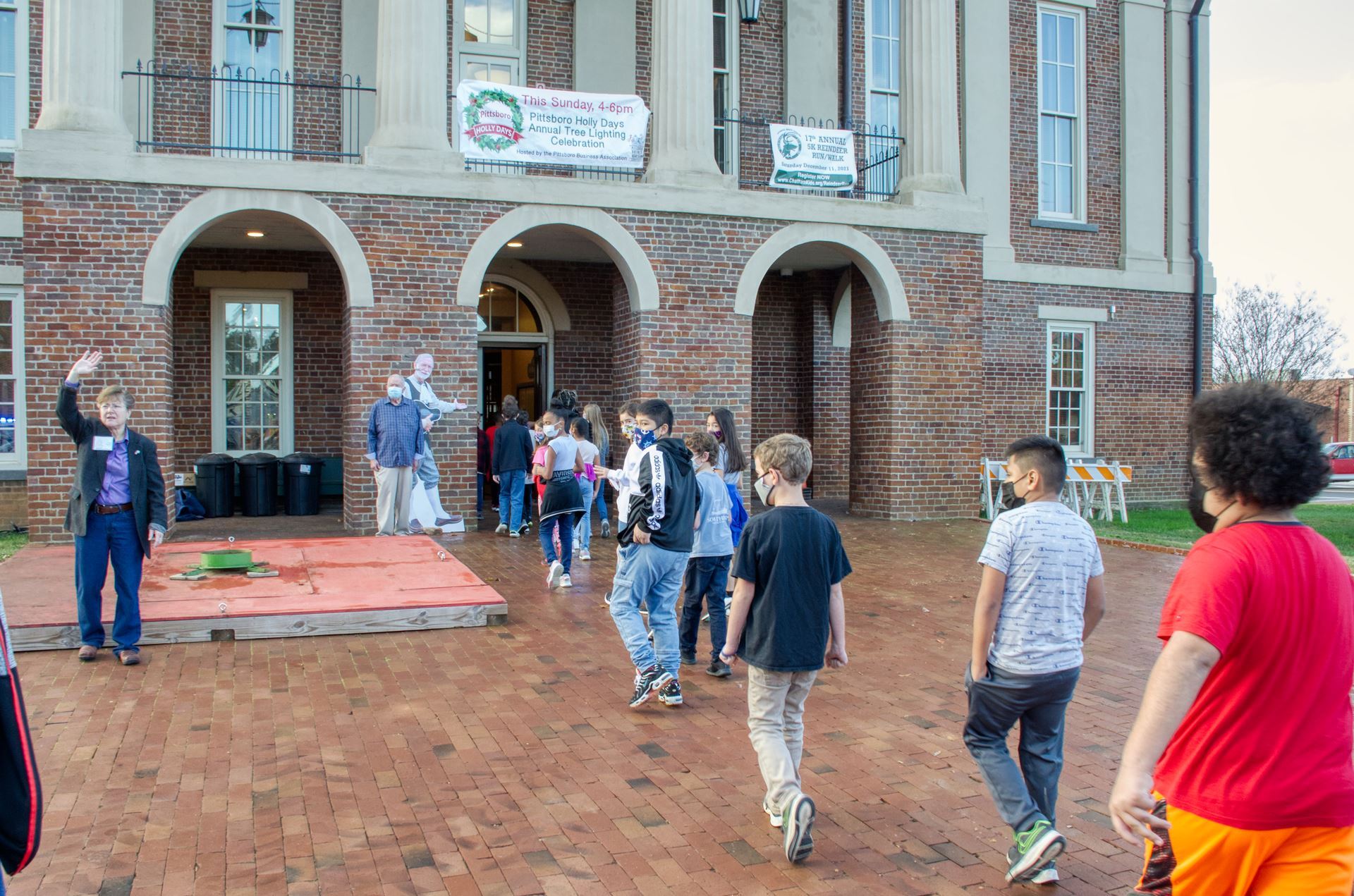
pictures and videos of events in and around the courthouse
over the years. These are not pictures of the fire but of
happenings in prior times. Of special interest are trials,
marches, rallies, parades, speeches and other events large
or small. Also of interest are are interior photographs
including those of architectural elements. The county plans
to create a short documentary about Chatham's Historic
Courthouse.
If you have any photos or videos
you would be willing to let the county use, contact Debra
Henzey at 542-8258 or Lisa West at 545-8483 or by email at
debra.henzey@chathamnc.org
or lisa.west@chathamnc.org.
Copies of Tales Beyond Fried Rabbit are now available for sale through our web orders
page.
Fred Vatter’s delightful saunter into some of
the many corners of Chatham County’s past tell us of old
houses, aged country stores, church yards with intriguing
gravestones, and venerable public buildings; settlements and
cemeteries now lost due to dams and other effects of
progress; ordinary people who know the county’s past and
would love to tell you about it, as well as prominent civic
leaders now long dead. Order Form
Virtual Tour
of Historic Chatham County - Over
the coming months and years, CCHA will be developing an online
"virtual tour" of sites of interest in Chatham County. The first
installment features two
Veterans' Memorial Sites, with photography by Barbara
Pugh.
CCHA has pledged $25,000 to
the
Chatham Community Library
to build and furnish an area in the new library devoted to
county history, heritage and genealogy.
Details
Most months, we feature an
article and or photograph. If you have an article or photograph
which you would like considered for use as a feature on this
website, please send it to
history@chathamhistory.org.
After the Civil War,
tenant farming and sharecropping became a way of
life for the vast majority of Southern farmers.
Chatham County was no exception. Most freed
slaves were without resources or access to
credit to purchase land, and
many became sharecroppers. Many small landowning
white farmers also lost their land in the
South’s devastated
economy in the years following the Civil War.
Many landless farmers—renters and
sharecroppers—could not hope to
escape from landlessness, debt, and poverty.
As the number of farm tenants increased in the
first three decades of the 20th century,
southern farm tenancy came to be
viewed by many as a problem—not only for the
tenants who were mired in poverty but also for
the larger society. Southern
farm tenancy was characterized by a single cash
crop agricultural system which resulted in ever
poorer land and
insufficient production of food for the farmer.
More than in other regions, southern farmers
faced a high cost of credit for financing farm
operations. And the tenant system provided
relatively little opportunity for rising up the
economic scale. Indeed, many small landowners
were just one bad crop away from landlessness.
Concern about the problem of farm tenancy
inspired a number of studies in the 1920s and
1930s as policy-makers
struggled with the question of what to do about
the inefficiency in farm operations and the
poverty among farming families
that it produced. One of those studies, carried
out in 1922 by the North Carolina Tenancy
Commission, focused on the
living conditions of both farm owners and
tenants in two Chatham County townships which
were chosen to represent the
piedmont section of the state. The researchers
interviewed almost every farmer—owner, renter,
and sharecropper—in Baldwin and Williams townships and
asked more than 700 questions covering a variety
of topics. These included the economic
situation of the families, their education, how
much of their own food they produced, what their
homes were like, their
health status, religious practices, and opinions
about various public and community improvements.
The study also looked at the degree to which
tenants were able to improve their situations.
Because two Chatham townships were included in
the 1922 Tenancy Commission study, we have
access to an unusual amount of data about that
part of the county at that point
in time—a fascinating snapshot of a time and
topic about which little is documented at the
local level.
CCHA members Jim and Beverly Wiggins stumbled
across the reports and have summarized the study
in the paper
“How
Farm Tenants Lived in Chatham County, NC in
1922.” The Wiggins say
that they learned a lot
about tenant farming in Chatham County from the
study. “Clearly, farming in general, not just
tenant farming, was a hard
way to make a living here in 1922,” said Jim
Wiggins. For example, none of the tenant homes
in the townships studied had
bathtubs, indoor toilets, or electric lights. In
this respect, farm owners fared not much
better—fewer than 2% of the homes
of farm owners had bathtubs, fewer than 1% had
an indoor toilet, and none had electric
lights—indicating that rural living in
Chatham in 1922 was still a rustic business. The
Wiggins’ paper, in PDF format, also provides
links to the original reports for those who wish
to read further, and a brief discussion, based
on other sources, of what brought the widespread
practice of tenant farming to an end throughout
the South.
Lange,
Dorothea, photographer. House of Negro tenant
family. Pittsboro, North Carolina. July 1939.
Library of Congress.